







ClimLabels I Beyond Environmental Factors: What Retail Investors Want from ESG Investing
Beyond Environmental Factors: What Retail Investors Want from ESG Investing
The reform of the EU’s sustainable finance framework, in particular the Sustainable Finance Disclosure Regulation (SFDR), reopens a debate about ESG labels and their alignment with investor preferences and policy objectives. This paper provides novel evidence on the role of ESG exclusion criteria in retail investment decisions. Using survey and experimental data from 1,174 German retail investors, we show that exclusion-based preferences are central to how investors interpret and use ESG labels. Investors place significantly greater weight on social and governance exclusions than on environmental ones (S > G > E), with human rights, animal welfare, and corruption emerging as dominant concerns. Experimental evidence further demonstrates that only investors with strong altruistic values adjust their portfolios when provided with granular ESG information. Consequently, reforms to the sustainable framework should acknowledge the importance of social and governance exclusions and move towards granular labels, while being aware of the limits of sustainability labelling on the green transition.
ClimLabels I Financing the Economic Transition — On the Role of Labels for Retail Investors
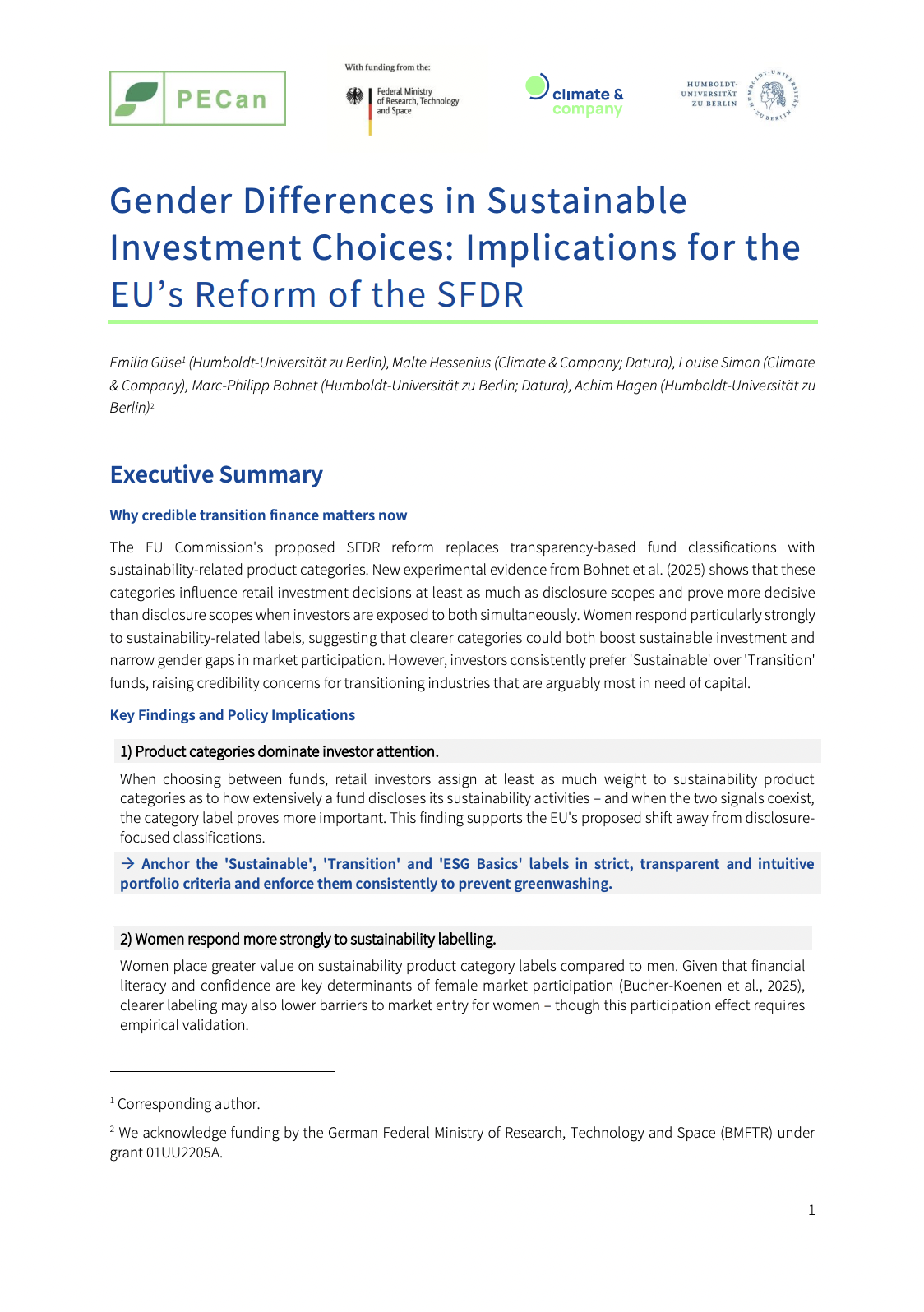
Gender Differences in Sustainable Investment Choices: Implications for the EU’s Reform of the SFDR
The EU Commission's proposed SFDR reform replaces transparency-based fund classifications with sustainability-related product categories. New experimental evidence from Bohnet et al. (2025) shows that these categories influence retail investment decisions at least as much as disclosure scopes and prove more decisive than disclosure scopes when investors are exposed to both simultaneously. Women respond particularly strongly to sustainability-related labels, suggesting that clearer categories could both boost sustainable investment and narrow gender gaps in market participation. However, investors consistently prefer 'Sustainable' over 'Transition' funds, raising credibility concerns for transitioning industries that are arguably most in need of capital.
ClimLabels I Gender Differences in Sustainable Investment Choices: Implications for the EU’s Reform of the SFDR

Financing the Economic Transition — On the Role of Labels for Retail Investors
The economic transition from a fossil-fueled economy to a green economy requires sub- stantial financing, including contributions from retail investors. What determines retail in- vestors’ willingness to pay (WTP) for sustainable investments is, however, an open ques- tion. In this paper, we address this question by examining the role of information and its presentation—particularly through labels—for retail investors’ WTP for sustainable invest- ments. Using an incentivized experiment with 1,219 German retail investors, we analyze how different presentations of information on environmental impact—ranging from plain text to labels with scores from one to five, under both loose and strict labeling standards— impact WTP. Our findings reveal that while retail investors exhibit a significant WTP for environmental impact, this WTP is only weakly influenced by the actual extent of this im- pact. Labels play a critical role: more demanding label standards enhance the sensitivity of WTP to environmental impact, whereas more lenient standards diminish this sensitivity. Moreover, warm-glow utility emerges as a key driver of the WTP for environmental impact. Higher label scores increase warm-glow utility even in the absence of changes in actual im- pact. Finally, the effect of warm-glow utility on WTP is stronger in label treatments.
ClimLabels I Integrating “transition” more systematically into finance
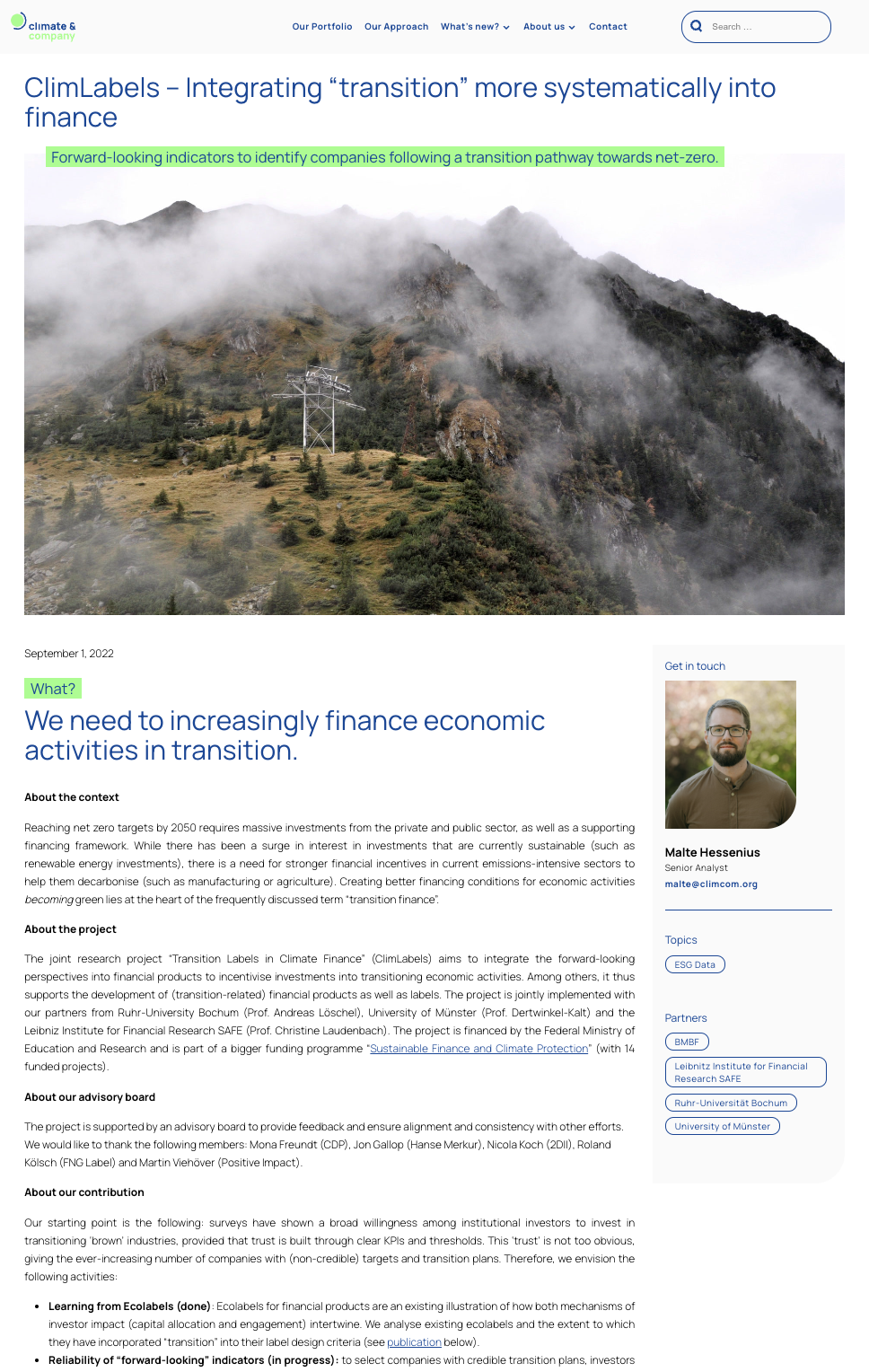
ClimLabels - Integrating “transition” more systematically into finance Forward-looking indicators to identify companies following a transition pathway towards net-zero.
About the context: Reaching net zero targets by 2050 requires massive investments from the private and public sector, as well as a supporting financing framework. While there has been a surge in interest in investments that are currently sustainable (such as renewable energy investments), there is a need for stronger financial incentives in current emissions-intensive sectors to help them decarbonise (such as manufacturing or agriculture). Creating better financing conditions for economic activities becoming green lies at the heart of the frequently discussed term “transition finance”. About the project: The joint research project “Transition Labels in Climate Finance” (ClimLabels) aims to integrate the forward-looking perspectives into financial products to incentivise investments into transitioning economic activities. Among others, it thus supports the development of (transition-related) financial products as well as labels. The project is jointly implemented with our partners from Ruhr-University Bochum (Prof. Andreas Löschel), University of Münster (Prof. Dertwinkel-Kalt) and the Leibniz Institute for Financial Research SAFE (Prof. Christine Laudenbach). The project is financed by the Federal Ministry of Education and Research and is part of a bigger funding programme “Sustainable Finance and Climate Protection” (with 14 funded projects).
ClimLabels I Investor Impact in Transition Finance: Learning from Ecolabels
Investor Impact in Transition Finance: Learning from Ecolabels
This publication is a first overview paper, originating from our ClimLabels project. This paper sheds light on the evolving transition finance landscape with a particular focus on Ecolabels and what we can learn from them to construct transition finance products. This paper builds partially on our input on the UK’s proposed transition label.
ClimLabels I Remarks on UK’s proposed transition investment label
Remarks on UK’s proposed transition investment label
The UK Financial Conduct Authority (FCA) has proposed three sustainable investment labels (i.e., sustainable focus, sustainable improvers, sustainable impact) in the form of a consultation paper (link). Our response to the consultation builds on research originating from our ClimLabels project, financed by the German Ministry of Education and Research (BMBF). The project analyses transition labels in climate finance. Our technical input therefore focuses on the “Sustainable Improvers” label, its qualifying criteria (in particular Question 9), and how (retail) investment can support Paris-aligned transition pathways and the decarbonisation of high-emitting sectors. To date, most efforts to align financial flows with the trajectory towards lower greenhouse gas emissions and the goals of the Paris Agreement, have focused on “dark green” sectors and economic activities. But there is also the urgent need to create and finance transition pathways of currently high-emitting sectors, if low-carbon technologies are available. Our main recommendations to improve the “Sustainable Improvers” label are the following: A clear reference to the Paris Agreement and the UK climate/ environmental targets creates the necessary ambition and prevents greenwashing. A reduction of the investable universe by excluding high-impact companies without transition plans increases the credibility of the label. Specific requirements for the engagement process for the manager of the fund improves the success rate of the stewardship process.
ClimLabels I Transition Products: Conceptual Clarity & Implementation Guidance

Transition Products: Conceptual Clarity & Implementation Guidance
This white paper is part of a wider discussion about new regulatory efforts in the EU, UK and beyond to categorise financial products with sustainability features. This report focuses on the category of ‘transition products’ in public equity markets. By reviewing existing proposals for transition products, we identify their key characteristics and potential criteria. As a next step, we illustrate the application of the potential criteria using a global universe of listed companies to provide evidence-based feedback to decision-makers.
ClimLabels I Transition Products, Retail Investor Preferences and the Reform of the SFDR
Transition Products, Retail Investor Preferences and the Reform of the SFDR
Why credible transition finance matters now. To deliver the EU Green Deal, restore investor confidence amid product confusion and maintain Europe’s market competitiveness, credible transition finance is essential. Anchored in German-funded, EU-relevant evidence, credible transition finance offers a practical route to delivering the Green Deal, rebuilding investor trust and strengthening Europe’s sustainable finance leadership. While the Sustainable Finance Disclosure Regulation (SFDR) is under review, evidence from the ClimLabels projects sheds light on both the supply and demand sides. On the supply side, the project analyses how transition products can be credibly designed while remaining financially competitive. On the demand side, it gathers empirical evidence on retail investors’ preferences, willingness to pay, and understanding of different SFDR product categories.