





Investment behavior in sustainable financial instruments: A behavioral-economic experimental analysis of "ESG preferences" and their implications for financial institutions and policies

ESGinvest

Investment behavior in sustainable financial instruments: A behavioral-economic experimental analysis of “ESG preferences” and their implications for financial institutions and policies

ESGinvest


The collaborative project “Investment behavior in sustainable financial instruments: A Behavioral Economic Experimental Analysis of “ESG Preferences” and their Implications for Financial Institutions and Policy” (ESGInvest) aims to provide new insights for policy and financial decision makers on the functioning and implications of ESG investments by private investors.


It examines both the ESG investment preferences of these investors directly and their indirect effects on the lending behavior of financial institutions. These findings form the basis for evaluating different policy measures to achieve climate goals with the help of the financial system.


The project is divided into the sub-project “ESGInvest: ESG investor preferences and ESG lending by banks”, which is implemented by the University of Mainz, and the sub-project “ESGInvest: Implications for real economic change processes”, which is implemented by Oxford Economics GmbH.

Subproject 1: Implications for real economic change processes

The first subproject combines already known challenges for the widespread demand for ESG financial products with the findings from the second subproject. Based on this, implications for real economic change processes towards a stronger commitment to climate protection are to be identified and initiated with the active involvement of relevant actors.

Subproject 2: ESG investor preferences and ESG lending by banks

The second subproject examines the ESG demand of retail investors in a cross-national field experiment regarding various influencing factors and investigates whether there are systematic differences between the countries under consideration. In addition, the project examines whether and to what extent the ESG preferences of retail investors influence the lending behavior of banks.

The Structure of Sustainable Investment Demand
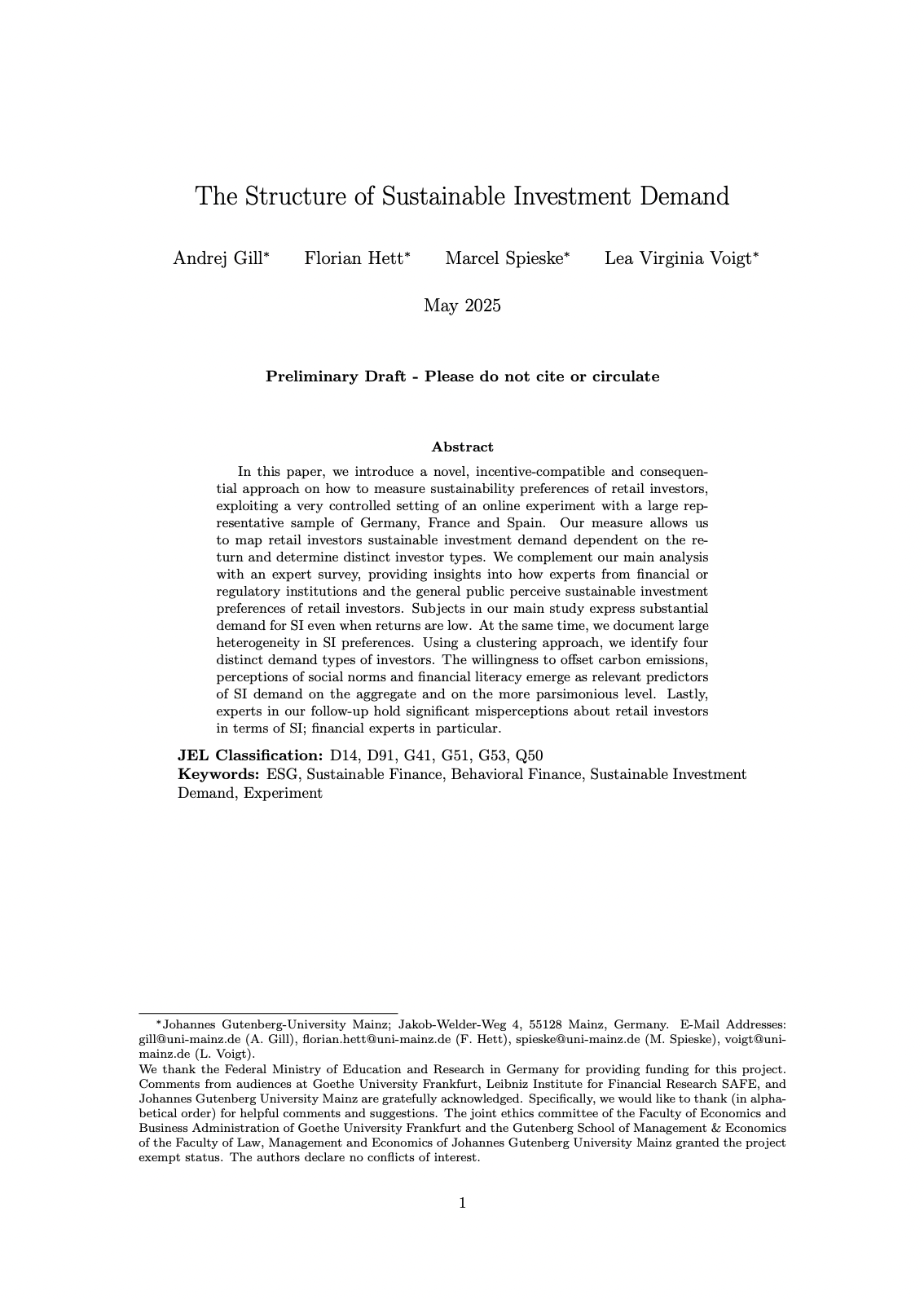
In this paper, we introduce a novel, incentive-compatible and consequential approach on how to measure sustainability preferences of retail investors, exploiting a very controlled setting of an online experiment with a large representative sample of Germany, France and Spain. Our measure allows us to map retail investors sustainable investment demand dependent on the return and determine distinct investor types. We complement our main analysis with an expert survey, providing insights into how experts from financial or regulatory institutions and the general public perceive sustainable investment preferences of retail investors. Subjects in our main study express substantial demand for SI even when returns are low. At the same time, we document large heterogeneity in SI preferences. Using a clustering approach, we identify four distinct demand types of investors. The willingness to offset carbon emissions, perceptions of social norms and financial literacy emerge as relevant predictors of SI demand on the aggregate and on the more parsimonious level. Lastly, experts in our follow-up hold significant misperceptions about retail investors in terms of SI; financial experts in particular.

General
Paper