






Climvest I Green investors and the return on capital in general equilibrium
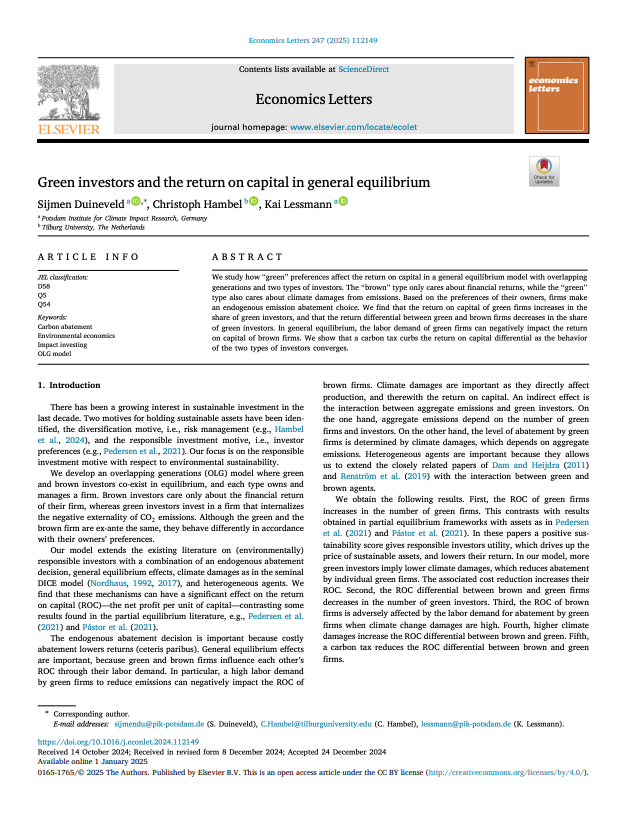
Green investors and the return on capital in general equilibrium
We study how “green” preferences affect the return on capital in a general equilibrium model with overlapping generations and two types of investors. The “brown” type only cares about financial returns, while the “green” type also cares about climate damages from emissions. Based on the preferences of their owners, firms make an endogenous emission abatement choice. We find that the return on capital of green firms increases in the share of green investors, and that the return differential between green and brown firms decreases in the share of green investors. In general equilibrium, the labor demand of green firms can negatively impact the return on capital of brown firms. We show that a carbon tax curbs the return on capital differential as the behavior of the two types of investors converges.
Climvest I Taste-Driven Capital Market Separation: Impact on Firm Valuation
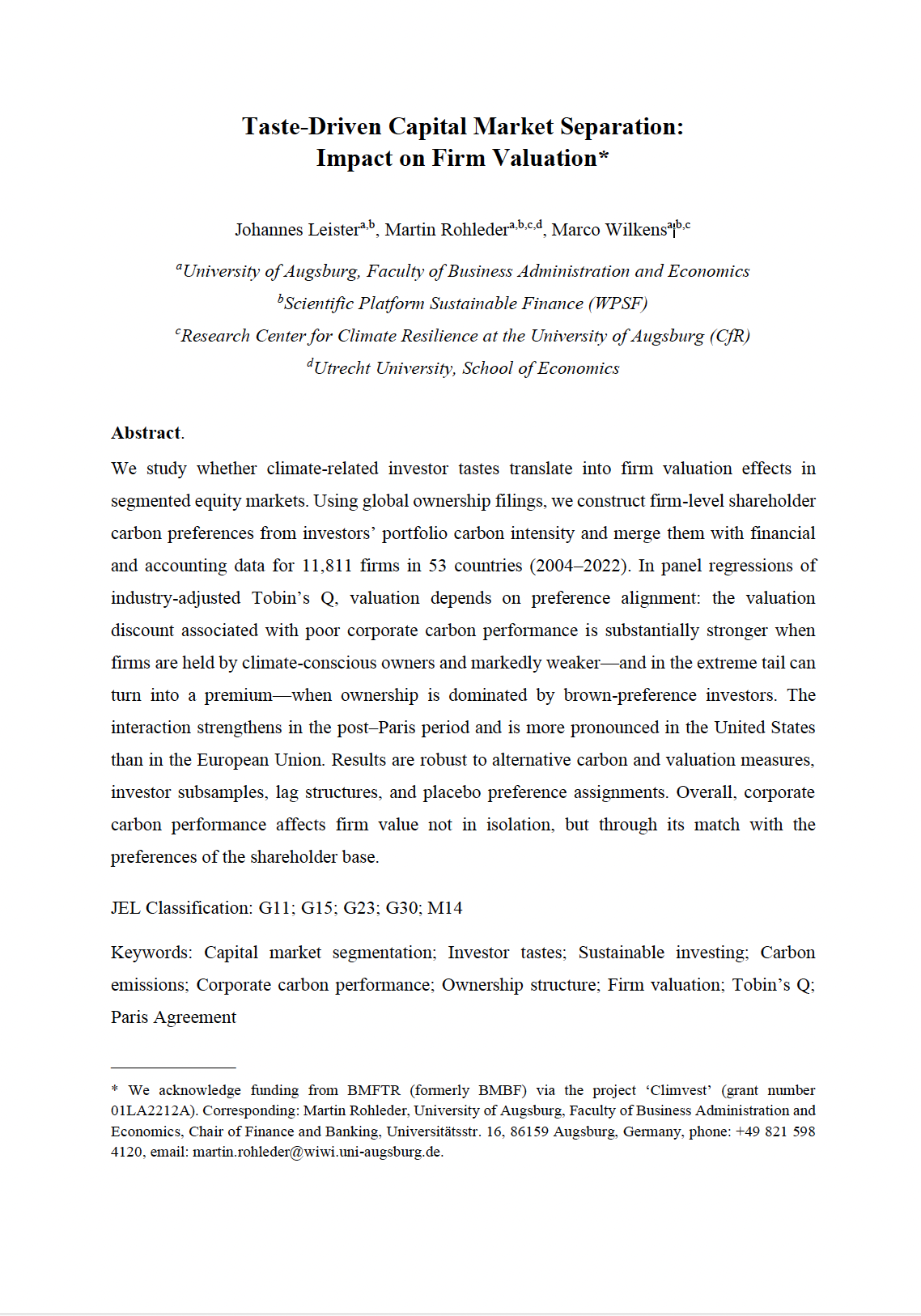
Taste-Driven Capital Market Separation: Impact on Firm Valuation
We study whether climate-related investor tastes translate into firm valuation effects in segmented equity markets. Using global ownership filings, we construct firm-level shareholder carbon preferences from investors’ portfolio carbon intensity and merge them with financial and accounting data for 11,811 firms in 53 countries (2004–2022). In panel regressions of industry-adjusted Tobin’s Q, valuation depends on preference alignment: the valuation discount associated with poor corporate carbon performance is substantially stronger when firms are held by climate-conscious owners and markedly weaker—and in the extreme tail can turn into a premium—when ownership is dominated by brown-preference investors. The interaction strengthens in the post–Paris period and is more pronounced in the United States than in the European Union. Results are robust to alternative carbon and valuation measures, investor subsamples, lag structures, and placebo preference assignments. Overall, corporate carbon performance affects firm value not in isolation, but through its match with the preferences of the shareholder base.
Climvest I The whole nine yards of climate? New evidence on approaches of climateoriented mutual funds
The whole nine yards of climate? New evidence on approaches of climateoriented mutual funds
We investigate the characteristics of European climate-oriented mutual funds from two different perspectives. Firstly, we analyze how different climate approaches of climateoriented mutual funds are associated with specific climate-related metrics. Secondly, we examine the financial performance of the identified approaches. Against this background, we collect the funds' self-declared climate approaches using Refinitiv's fund database. We find heterogeneity among the climate approaches in terms of the relevance of various climate metrics. Furthermore, we find that none of the funds' climate approaches achieve lower risk-adjusted returns. Our findings are relevant for investors, who might have different expectations as to what certain climate approaches should imply in terms of both specific climate metrics as well as financial performance. This study constitutes an important contribution to the literature on climate-oriented investments as most studies fall short to account for the granularity of different climate approaches and climate metrics.
Climvest I The Alignment of Corporate Carbon Performance and Shareholder Preferences: Evidence of a Capital Market Separation
The Alignment of Corporate Carbon Performance and Shareholder Preferences: Evidence of a Capital Market Separation
The growing focus on climate change and sustainability has reshaped financial markets, leading to a separation where firms and investors are clustered based on their environmental performance. This study is the first to empirically test the predicted capital market separation, wherein climate-conscious investors primarily hold firms with strong carbon performance, while financially driven investors retain those with weaker climate records. Using a large global dataset of stock ownership and carbon metrics from 2004 to 2022, we provide the first large-scale empirical evidence of this phenomenon. We show that green firms consistently concentrate in sustainability-focused portfolios, whereas brown firms remain in traditional investor holdings. The market separation intensifies over our sample period and differs between geographic regions. Interestingly, the Paris Agreement significantly altered market dynamics: post-Paris, separation intensified in the U.S., while were less pronounced in the EU. Robustness checks, including placebo tests, financial performance controls, and alternative measures of carbon performance, confirm our findings. Our research contributes to the literature by offering novel insights into how shareholders’ carbon-preferences shape capital allocation, with implications for corporate strategy, investment management, and policy development.
Climvest I Towards Granular Climate Transparency in Mutual Funds: Informing the SFDR Review
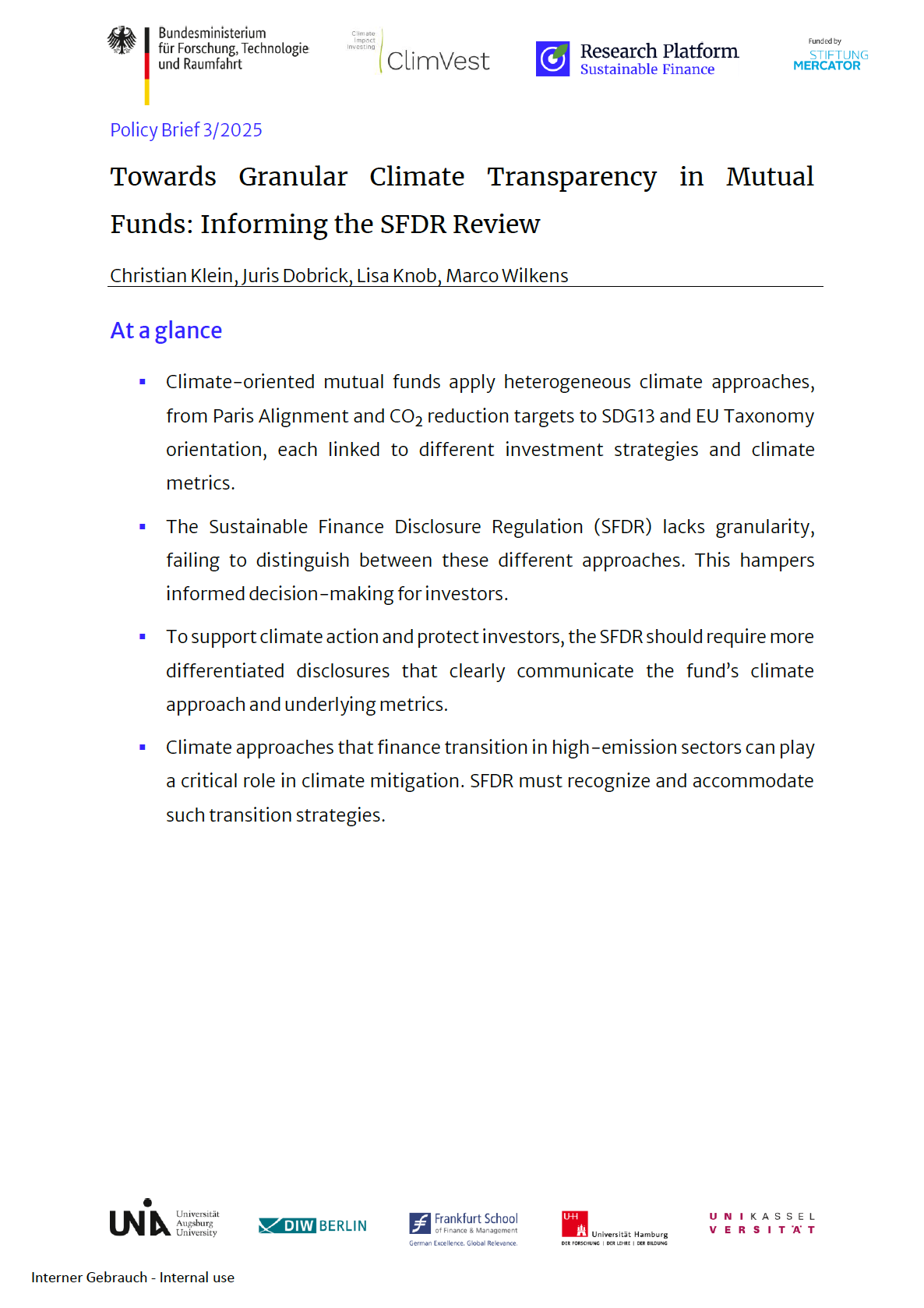
Towards Granular Climate Transparency in Mutual Funds: Informing the SFDR Review
Capital markets are supposed to play a central role in closing the climate investment gap (European Commission 2018; Andersen 2022). Mutual funds, as widely used investment products, are increasingly expected to channel capital towards closing the finance gap to achieve the goals of the Paris Agreement (Andersen 2022). Recent regulatory initiatives such as the SFDR aim to enhance transparency around the sustainability information of such funds, thereby empowering investors to make informed decisions and ensuring that capital is steered towards the transition to a net-zero economy. However, despite these efforts, the current disclosure regime does not sufficiently reflect the diversity and complexity of climate approaches employed by climateoriented mutual funds. Investors might face challenges in understanding what a fund’s climate approachactually implies (Andrikogiannopoulou et al. 2022). This lack of granularity, also found as a general research restriction in sustainability (Edmans 2023), is particularly problematic in light of the heterogeneity among climateoriented funds, which differ substantially in terms of their strategic approach (Popescu et al. 2021), e.g., Paris-aligned, CO₂ reduction-focused, SDG13-driven, or EU Taxonomy-based This policy brief summarizes key findings from a recent empirical study on 622 European climate-oriented mutual funds, which identifies four dominant climate strategies and analyzes their relationship with specific climate metrics and financial performance. The findings provide timely and policy-relevant insights for the ongoing revision of the SFDR. They underline the importance of recognizing transition-oriented investment strategies and advocate for a more differentiated disclosure framework that enables investors and regulators alike to distinguish between distinct climate approaches within the fund universe.